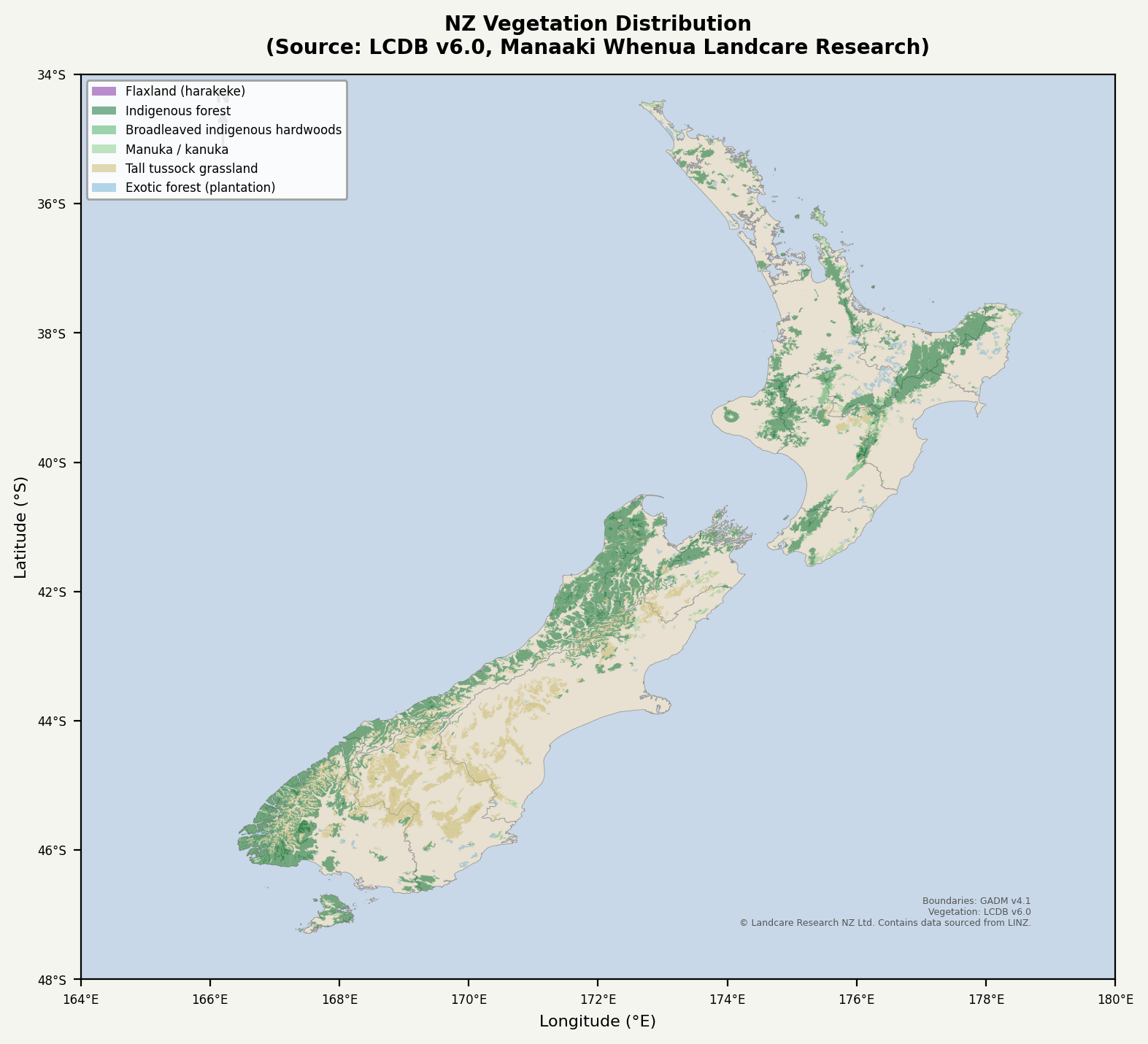
This reference covers native and introduced plants relevant to post-disruption recovery. Nuclear winter resilience ratings reflect tolerance of reduced light, cool temperatures, and shortened growing seasons — not survivability of acute radiation exposure.1
Table 1: Key NZ Plants for Recovery
Approximately 65 entries spanning native species, introduced crops, plantation timber, fruit, and pasture. Nuclear winter resilience (NWR) is rated High/Medium/Low based on shade tolerance and cold hardiness.2
| Common Name | Māori Name | Scientific Name | Type | Primary Use | Secondary Uses | Habitat | Harvest Season | Growth Rate | NWR |
|---|---|---|---|---|---|---|---|---|---|
| Kauri | Kauri | Agathis australis | tree | timber | resin, gum | North Is. lowland forest | Year-round (timber) | Very slow | Low |
| Rimu | Rimu | Dacrydium cupressinum | tree | timber | food (berries), carving | Both islands, forest | Year-round (timber) | Slow | Medium |
| Totara | Totara | Podocarpus totara | tree | timber | carving, fence posts | Both islands, diverse | Year-round (timber) | Slow | Medium |
| Matai | Matai | Prumnopitys taxifolia | tree | timber | flooring, food (berries) | Both islands, lowland | Autumn (berries) | Slow | Medium |
| Kahikatea | Kahikatea | Dacrycarpus dacrydioides | tree | timber | food (berries/koroi) | Wetland margins, both islands | Autumn (berries) | Medium | High |
| Tawa | Tawa | Beilschmiedia tawa | tree | timber | food (berries), fuel | North Is. lowland | Autumn (berries) | Medium | Medium |
| Puriri | Puriri | Vitex lucens | tree | timber | medicine (bark), fuel | North Is. coastal forest | Year-round | Medium | Low |
| Pohutukawa | Pohutukawa | Metrosideros excelsa | tree | timber | medicine, erosion control | North Is. coastal | Dec–Jan (flowers) | Medium | Low |
| Manuka | Manuka | Leptospermum scoparium | shrub | medicine | fuel, honey, timber (small) | Both islands, disturbed land | Oct–Feb (flowers) | Fast | High |
| Kanuka | Kanuka | Kunzea ericoides | tree | timber | fuel, medicine, honey | Both islands, open land | Nov–Mar (flowers) | Fast | High |
| Kowhai | Kowhai | Sophora microphylla | tree | medicine | nitrogen fixation, timber | Riverbanks, forest margins | Aug–Oct (flowers) | Medium | Medium |
| Northern rata | Rata | Metrosideros robusta | tree | timber | fuel, medicine | North Is. forest | Dec–Feb (flowers) | Very slow | Medium |
| Red beech | Tawhairaunui | Fuscospora fusca | tree | timber | fuel, honeydew (food) | South Is. montane | Year-round (timber) | Slow | High |
| Silver beech | Tawhai | Lophozonia menziesii | tree | timber | fuel | South Is. montane/subalpine | Year-round (timber) | Slow | Very high |
| Hard beech | Tawhairauriki | Fuscospora truncata | tree | timber | fuel, tool handles | Both islands, lowland | Year-round (timber) | Slow | High |
| Harakeke | Harakeke | Phormium tenax | herb | fiber | food (pollen), medicine | Wetlands, roadsides, both is. | Year-round (leaves) | Medium | High |
| Mountain flax | Wharariki | Phormium cookianum | herb | fiber | weaving | Coastal/subalpine, both is. | Year-round (leaves) | Medium | Very high |
| Cabbage tree | Ti kouka | Cordyline australis | tree | fiber | food (growing tip), medicine | Wetland margins, both islands | Spring (growing tip) | Medium | High |
| Pingao | Pingao | Ficinia spiralis | grass | fiber | weaving (golden color) | Coastal sand dunes | Year-round | Slow | High |
| Nikau palm | Nikau | Rhopalostylis sapida | tree | food | fiber, thatch | North Is./Marlborough forest | Year-round | Very slow | Low |
| Raupo/Bulrush | Raupo | Typha orientalis | herb | fiber | food (pollen/rhizomes), thatch | Wetlands, both islands | Summer (pollen) | Fast | High |
| Karaka | Karaka | Corynocarpus laevigatus | tree | food | timber (small) | North Is. coastal forest | Autumn (berries) | Medium | Low |
| Hinau | Hinau | Elaeocarpus dentatus | tree | food | dye (bark), timber | Both islands, forest | Autumn (berries) | Medium | Medium |
| Supplejack | Kareao | Ripogonum scandens | shrub | food | fiber (vine), basket weaving | Lowland forest, both islands | Spring (shoots) | Fast | Medium |
| Pikopiko | Pikopiko | Deparia petersenii | fern | food | n/a | Damp forest, both islands | Spring (fronds) | Fast | High |
| Puha/Sowthistle | Puha | Sonchus oleraceus | herb | food | medicine | Disturbed ground, widespread | Year-round | Fast | High |
| Kawakawa | Kawakawa | Piper excelsum | shrub | medicine | food (berries), insect repellent | Coastal/lowland forest, N.Is. | Year-round | Medium | Low |
| Horopito | Horopito | Pseudowintera colorata | shrub | medicine | antiseptic, analgesic | Forest, both islands | Year-round (leaves) | Slow | High |
| Koromiko | Koromiko | Veronica stricta | shrub | medicine | wound dressing | Open scrub, both islands | Nov–Feb (flowers) | Fast | High |
| Kiekie | Kiekie | Freycinetia banksii | shrub | food | fiber, weaving | Lowland forest, North Is. | Spring–summer | Medium | Low |
| Mamaku | Mamaku | Cyathea medullaris | fern | food | shade/shelter (tree fern) | Damp forest, both islands | Year-round (pith) | Medium | High |
| Ponga/Silver fern | Ponga | Cyathea dealbata | fern | food | symbol/navigation (white back) | Forest, South Is. | Year-round | Medium | High |
| Potato | Taewa | Solanum tuberosum | herb | food | starch, alcohol | Agricultural, NZ-wide | Mar–May (harvest) | Fast | High |
| Kumara | Kumara | Ipomoea batatas | herb | food | starch | North Is., warm coastal | Mar–Apr (harvest) | Fast | Medium |
| Wheat | Witi | Triticum aestivum | grass | food | straw (thatch, fiber) | Canterbury, Hawke’s Bay | Dec–Jan (harvest) | Fast | Medium |
| Barley | Pali | Hordeum vulgare | grass | food | animal feed, malting | Canterbury, Otago | Dec–Jan (harvest) | Fast | High |
| Oats | — | Avena sativa | grass | food | animal feed, straw | South Is., cool temperate | Jan–Feb (harvest) | Fast | Very high |
| Maize/Corn | Kaanga | Zea mays | grass | food | starch, fuel (stalks) | Northland, Waikato | Feb–Apr (harvest) | Fast | Low |
| Brassicas (kale etc.) | — | Brassica spp. | herb | food | animal feed, oil (seed) | Agricultural, NZ-wide | Year-round | Fast | High |
| Peas | — | Pisum sativum | herb | food | nitrogen fixation | Cool-season, NZ-wide | Nov–Jan | Fast | High |
| Beans | — | Phaseolus vulgaris | herb | food | nitrogen fixation | Warm areas, NZ-wide | Jan–Mar | Fast | Medium |
| Pinus radiata | — | Pinus radiata | tree | timber | paper pulp, fuel, resin | Plantations, CNI/Nelson/Cant. | Year-round (timber) | Very fast | Medium |
| Douglas fir | — | Pseudotsuga menziesii | tree | timber | structural timber | Plantations, South Is. | Year-round (timber) | Fast | High |
| Macrocarpa | — | Cupressus macrocarpa | tree | timber | shelterbelts, outdoor furniture | Farms, both islands | Year-round (timber) | Fast | High |
| Eucalyptus | — | Eucalyptus spp. | tree | fuel | timber (some spp.), windbreak | Farms, both islands | Year-round | Very fast | Medium |
| Poplar | Popara | Populus spp. | tree | timber | erosion control, fuel | Riparian zones, both islands | Year-round (timber) | Very fast | High |
| Willow | — | Salix spp. | tree | timber | erosion control, weaving (withy) | Riparian zones, both islands | Year-round | Very fast | High |
| Apple | — | Malus domestica | tree | food | cider/vinegar, wood | Hawke’s Bay, Nelson, Otago | Mar–May (harvest) | Medium | Medium |
| Pear | — | Pyrus communis | tree | food | wood (tool handles) | Both islands, orchards | Mar–Apr (harvest) | Medium | Medium |
| Kiwifruit | — | Actinidia deliciosa | shrub | food | vitamin C | Bay of Plenty, Northland | Apr–Jul (harvest) | Fast | Low |
| Feijoa | — | Acca sellowiana | shrub | food | windbreak | North Is., sheltered | Apr–Jun (harvest) | Medium | Medium |
| Tamarillo | — | Solanum betaceum | shrub | food | vitamin C | Northland, warm coastal | Jun–Oct (harvest) | Fast | Low |
| Citrus | — | Citrus spp. | tree | food | vitamin C, preservative (juice) | Northland, Auckland coast | Jun–Sep (harvest) | Medium | Low |
| Grape/Vine | — | Vitis vinifera | shrub | food | alcohol, vinegar, dried fruit | Marlborough, Hawke’s Bay, Otago | Feb–Apr (harvest) | Fast | Medium |
| Perennial ryegrass | — | Lolium perenne | grass | pasture | hay, silage | Improved pasture, NZ-wide | Year-round | Fast | High |
| White clover | Koware ma | Trifolium repens | herb | pasture | nitrogen fixation, honey | Improved pasture, NZ-wide | Year-round | Fast | High |
| Lucerne/Alfalfa | — | Medicago sativa | herb | pasture | nitrogen fixation, hay | Dry regions, Canterbury/HB | Nov–Mar (cuts) | Fast | Medium |
| Chicory | — | Cichorium intybus | herb | pasture | food (root/leaf), medicine | Improved pasture, NZ-wide | Year-round | Fast | High |
| Plantain (herb) | Kopakopa | Plantago lanceolata | herb | pasture | medicine (wound), animal feed | Pasture/roadsides, NZ-wide | Year-round | Fast | Very high |
| Hemp | — | Cannabis sativa | herb | fiber | oil (seed), medicine | Warm regions (licensed crops) | Autumn (harvest) | Fast | Medium |
| Linen flax | — | Linum usitatissimum | herb | fiber | oil (linseed), food | Cool temperate, South Is. | Summer (harvest) | Fast | High |
| Bracken fern | Rahurahu | Pteridium esculentum | fern | food | thatch, medicine | Disturbed land, NZ-wide | Spring (shoots) | Fast | Very high |
| Tussock grasses | Pungapunga | Chionochloa spp. | grass | fiber | thatch, animal shelter | High country, South Is. | Summer | Slow | Very high |
NWR key: High = tolerates 30–50% light reduction and temperatures 3–5°C below normal seasonal averages; Medium = moderate tolerance; Low = requires near-normal conditions. ‘Very high’ entries are noted inline.
Table 2: Fiber Plants — Detail
Plants usable for rope, cloth, thatch, weaving, netting, and basketry. Processing complexity varies significantly between bast fibers (hemp, linen) and direct-use leaf fibers (harakeke, cabbage tree).3
| Plant | Scientific Name | Fiber Type | Processing Method | Products | Yield Estimate |
|---|---|---|---|---|---|
| Harakeke (NZ flax) | Phormium tenax | Long leaf fiber | Strip, scrape, dry — ret or direct use | Rope, cloth, kete (baskets), nets, sandals, twine | ~2–4 kg dry fiber/plant/year from mature clump |
| Mountain flax | Phormium cookianum | Long leaf fiber | As harakeke; finer fiber quality | Delicate weaving, fine cord | Lower yield than harakeke; more variable |
| Cabbage tree | Cordyline australis | Leaf fiber | Split leaves, dry; inner leaf bundles best | Rope, twine, coarse cloth, sandal soles | Coarser than flax; harvest without killing plant |
| Pingao | Ficinia spiralis | Stem fiber | Harvest dried stems; no processing needed | Premium weaving (golden color), kete, tukutuku panels | Slow-growing; dune habitat limits harvest |
| Raupo/Bulrush | Typha orientalis | Leaf/stem fiber | Split leaves, dry; fluffy seed head for stuffing | Thatch, matting, basket weaving, insulation (seed down) | High biomass; very productive wetland plant |
| Tussock grasses | Chionochloa spp. | Leaf fiber | Harvest dry; bundle for thatch | Thatching, coarse rope, animal bedding | High country; very large stands |
| Hemp | Cannabis sativa | Bast fiber (stem) | Ret, break, scutch, hackle — full retting process | Rope, canvas, coarse cloth, nets, sacking | ~1–2 tonnes dry fiber/ha; requires licensing in NZ |
| Linen flax | Linum usitatissimum | Bast fiber (stem) | Water ret 10–14 days, dry, break, hackle | Fine cloth, thread, cordage, canvas | ~800–1200 kg fiber/ha; labor-intensive processing |
Note on harakeke: Traditionally the most important fiber plant in Aotearoa. A well-managed clump of 20–30 plants can supply a household’s cordage and weaving needs. Harvest protocol: never cut the central shoot (rito) or the two flanking leaves — this kills the plant. Take outer leaves only, in pairs.4
Table 3: Timber Properties
Durability class follows NZS 3602 (Class 1 = most durable, Class 4 = least). All figures are approximate ranges; actual properties vary by site, age, and processing. Plantation species’ properties differ from those grown in natural conditions.5
| Common Name | Scientific Name | Density (kg/m³) | Hardness | Durability Class | Typical Uses | Growth Rate | Availability |
|---|---|---|---|---|---|---|---|
| Kauri | Agathis australis | 530–610 | Moderate | Class 2 (in-ground) | Furniture, joinery, boat building | Very slow (200–300 yr) | Rare — protected; salvage only |
| Rimu | Dacrydium cupressinum | 530–580 | Moderate | Class 2 | Furniture, flooring, joinery | Very slow (150+ yr) | Limited — old-growth; plantation trials ongoing |
| Totara | Podocarpus totara | 480–530 | Moderate | Class 1 (best native) | Fencing, wharves, carving, boatbuilding | Slow (80–120 yr) | Limited; some second-growth available |
| Matai | Prumnopitys taxifolia | 700–800 | Hard | Class 2 | Flooring, heavy framing | Slow (100+ yr) | Very limited |
| Kahikatea | Dacrycarpus dacrydioides | 420–480 | Soft | Class 3–4 | Interior joinery, boxes, butter casks (historic) | Medium (60–80 yr) | Limited; wet-site specialist |
| Red beech | Fuscospora fusca | 680–750 | Hard | Class 2 | Flooring, heavy construction, fuel | Slow (80–150 yr) | South Is. beech forests; moderate availability |
| Tawa | Beilschmiedia tawa | 700–780 | Hard | Class 3 | Flooring, tool handles, turnery | Medium (60–80 yr) | Moderate — North Is. second-growth |
| Puriri | Vitex lucens | 900–1000 | Very hard | Class 1 | Posts, wharves, heavy construction | Medium (50–70 yr) | Limited — North Is. coastal; some planted |
| Manuka | Leptospermum scoparium | 800–900 | Hard | Class 1 (posts) | Fence posts, tool handles, fuel | Fast (15–25 yr, small) | Abundant on disturbed land NZ-wide |
| Kanuka | Kunzea ericoides | 750–850 | Hard | Class 1 (posts) | Fence posts, firewood, tool handles | Fast (20–30 yr, small) | Abundant, both islands |
| Pinus radiata | Pinus radiata | 480–550 | Soft–Mod. | Class 4 (untreated) | Framing, pallets, paper, general construction | Very fast (25–30 yr) | Enormous supply — NZ’s main plantation timber |
| Douglas fir | Pseudotsuga menziesii | 500–560 | Moderate | Class 3 | Structural framing, heavy timber, decking | Fast (35–45 yr) | Good availability — South Is. plantations |
| Macrocarpa | Cupressus macrocarpa | 480–560 | Moderate | Class 2 | Outdoor furniture, fencing, joinery | Fast (30–40 yr) | Widespread on farmland |
| Eucalyptus | Eucalyptus spp. | 600–900 | Hard | Class 1–2 (varies) | Posts, poles, fuel, flooring (some spp.) | Very fast (10–20 yr) | Plantations + scattered farm trees |
| Poplar | Populus spp. | 380–450 | Soft | Class 4 | Packaging, matches, temporary construction | Very fast (8–15 yr) | Riparian zones; abundant |
| Willow | Salix spp. | 400–480 | Soft–Mod. | Class 3–4 | Basketry, cricket bats, charcoal | Very fast (5–12 yr) | Riparian zones; abundant |
Priority for recovery timber production: Pinus radiata offers the fastest path to structural timber (25–30 years to harvest). Manuka and kanuka are immediately available on most North Island disturbed land and provide Class 1 fence posts — critical for stock control — within 15 years. Totara, if planted now, provides the best long-term in-ground durability of any readily plantable native.6
Table 4: Seasonal Harvest Calendar
Month-by-month guide to what is available for harvest under normal seasonal conditions. Nuclear winter or El Niño conditions may shift timing by 2–6 weeks. Year-round items (puha, raupo rhizomes, mamaku pith, harakeke leaves) are omitted from individual months for brevity — assume constant availability.7
| Month | Available for Harvest |
|---|---|
| Jan | Wheat (harvest); Barley (harvest); Maize (ripening); Supplejack shoots (end); Manuka/kanuka flowers; Grape (veraison); Pikopiko (late) |
| Feb | Wheat (late); Grape (harvest starts); Maize (harvest); Peas (late); Beans (harvest); Tawa berries (developing) |
| Mar | Potato (harvest); Apple (harvest); Pear (harvest); Grape (harvest peak); Kumara (harvest); Beans (harvest); Rimu berries |
| Apr | Kumara (harvest); Apple (late); Kiwifruit (harvest starts); Feijoa (harvest); Grape (late); Hinau berries; Raupo rhizomes |
| May | Kiwifruit (harvest); Citrus (early harvest); Feijoa (late); Karaka berries (ripe); Mamaku pith (year-round); Raupo rhizomes |
| Jun | Citrus (harvest); Tamarillo (harvest starts); Winter greens/brassicas; Puha (year-round); Bracken rhizomes |
| Jul | Citrus (harvest); Tamarillo (harvest); Brassicas; Ponga fronds (limited); Bracken rhizomes |
| Aug | Kowhai flowers (bird food signal); Brassicas; Early potato planting; Puha (year-round); Bark collection (before sap rise) |
| Sep | Pikopiko fronds (first flush); Supplejack shoots; Bracken shoots; Kowhai flowers; Early brassica |
| Oct | Pikopiko (peak); Supplejack shoots; Cabbage tree growing tip; Manuka flowers (early); Kiekie spadix |
| Nov | Peas (harvest starts); Pikopiko (late); Manuka/kanuka flowers; Raupo pollen (early); Koromiko flowers |
| Dec | Raupo pollen (peak); Manuka flowers (peak); Pohutukawa flowers; Peas (peak); Early maize; Wheat (early harvest) |
Critical gap: June–August is the leanest period for fresh plant food. Preserved stores (dried karaka kernel8, dried berries, grain), citrus fruit, and brassicas are the primary fresh sources. This is the period most vulnerable to nutritional shortfall in a scenario with degraded food supply chains.
DOC (Department of Conservation). Native Plants of New Zealand. Wellington: DOC, 2023. Shade-tolerance data from Landcare Research Manaaki Whenua plant database.↩︎
NZPCN (New Zealand Plant Conservation Network). Species accounts. https://www.nzpcn.org.nz. Accessed 2026. Cold-hardiness ratings cross-referenced with Bannister & Neuner (2001), Plant Cold Hardiness.↩︎
Landcare Research. Economic Native Plants Research. Lincoln: Manaaki Whenua Press, 2019.↩︎
Rongomatane Trust. Harakeke Harvest Protocols. Palmerston North, 2018. Yield estimates from Scion Research field trials, Rotorua.↩︎
NZS 3602:2003. Timber and Wood-Based Products for Use in Building. Standards New Zealand, Wellington. Density ranges from BRANZ (2020), New Zealand Timber Properties Handbook.↩︎
Scion Research. Plantation Forestry Species Evaluation Reports, 2022. Rotorua: Scion. https://www.scionresearch.com↩︎
Crowe, A. A Field Guide to the Native Edible Plants of New Zealand. Auckland: Penguin, 2004. Seasonal timing adjusted for climate zone variation (Northland vs. Southland ~3–4 weeks difference).↩︎
Karaka berries contain karakin (toxic glucoside) in the seed flesh; the kernel must be prepared by prolonged cooking or fermentation before consumption. Raw consumption is dangerous. See Crowe (2004) for preparation detail.↩︎